Showing posts with label Transracial Adoption. Show all posts

May 03, 2011

Expanding the Family

Kristin asks:
Question for you (that I've been dying to ask, but felt it was inappropriately intrusive...Now since you've opened the door...): what are your current thoughts on expanding your family? I have lots of follow up questions, but I'll just leave it at that for now.
I sort of dread talking about this, not because it's intrusive (you're fine, Kristin!), but because it's such a loaded, sensitive topic. Opening my mouth makes me feel like the proverbial bull in the china shop of other's emotions. And family building, no matter the avenue, is so complex an issue that it's impossible to share all the small and large factors that go into a decision. Then there are the things you assume are just givens, but it turns out aren't and everyone gets riled up. But I'll give it a shot.

The truth? If adoption were just about what Todd and I wanted, I would love to adopt another child. Like, yesterday. But it's not all about us and adopting isn't a neutral act, so we're stuck between a whole lot of conflicting values and logistics.

Before I go on, I want to make it clear that everything I'm about to say only pertains to me and my family. It is not about you or anyone else. This isn't a commentary on people who made different decisions or value different things. I really mean that.

That said, this is our reality:
  • We would want to adopt a Black child. It doesn't seem fair to Mari to add yet another White person to the family and we don't think we we could do transracial parenting in the way we want to do it if we had children of three different races/ethnicities. I know many families do, but we don't think we could do it well in our context.
  • There are only two local agencies that we be comfortable working with if we were to adopt again. (Well, maybe 1.5. Or 2.25. It's a nebulous thing.) They only place one or two African-American children per year, if that (which reflects local demographics), so they're not realistic options.
  • I know there are lots of agencies in other states who focus on placing African-American children (although many have race-based fee structures, which are a no-go for us).  But I'm not comfortable adopting transracially from outside of our region. We live in a really monochromatic part of the country. Even our urban centers are overwhelmingly White. I personally (Todd disagrees with me on this one) have a hard time justifying taking a Black child from a place where they would have grown up not in the minority, or less so, to raise them here. I am not at all saying there were not significant losses connected to Mari being adopted transracially. Just that this would have been her home state, regardless, and it's also where her first parents live. 
  • Private infant adoption services in the United States are market-based to a great extent. I don't think you can reduce supply/demand economics to the ultra-micro level of a single household's decision to adopt, but our choices as adopting parents are the major force in the aggregate. I'm not even sure what I'm trying to say here and I do think there is such a thing as thoughtful, ethical infant adoption. I just know that if I imagine myself saying, "Yes! Let's adopt another baby!" and initiating another adoption, it doesn't totally sit right with me and this is part of that discomfort.
If I had to guess, I'd say our permanent family is probably done now. I'm a bit sad about that. I'm also totally in love with the little four-person family we have now. It's a parallel emotion sort of thing.

Eddie really, really, really wants another sibling. One who lives with us, he often adds. He talks about it a lot.

We're still working through all our paperwork to possibly foster and I think the interview part of the home study will probably start this summer. While, should it all come to pass, that will be an expansion of our family in another sort of way, it's separate in my mind from the question of whether or not to adopt again.

December 20, 2010

Christmas Books for Our Multiracial Family

My confession for the day: I have a weakness for Christmas books. Our new-ish tradition of wrapping up twenty-four books to be unwrapped and read one at a time over the nights leading up to Christmas gave me an excuse to add to our collection a couple of years ago. But I haven't been able to resist adding even more. There are too many wonderful books out there and it's such a joy to pull them out of storage every year. Thankfully Mari and Eddie are so far as fond of them as I am.

I've particularly been focusing on adding books with black characters. It's positive for Eddie to see some of the world's diversity reflected in our collection, of course. But it's especially important to me that Marian be able to place herself easily within the stories, especially those depicting the Nativity. We're surrounded by white faces in the holiday decorations at the stores, in the holiday specials on television, in most of the nativity scenes we see, and every Santa in the mall. Our Christmas books, like the decorations in our own home, are one tiny way of pressing back against that. Here are some of our favorite Christmas books for the preschool-and-under set featuring African-Americans, Africans, and even a Jamaican family living in England.

Christmas for 10Christmas for 10 by Cathryn Falwell is a rhyming count-up story in the same style as her classic Feast for 10. It's a cutie-patootie book that's a good length for toddlers. With its bouncy text and happy children, it's been a favorite of both my kids.
How Many Miles To Bethlehem?How Many Miles To Bethlehem? by Kevin Crossley-Holland and illustrated by Peter Malone, is a different take on the Christmas story. It assumes you know the basic plot and instead has everyone from the Magi to Jesus sharing small glimpses of what they're thinking and feeling. The Renaissance-style pictures depict a variety of ethnicities and Mary is brown-skinned with crimped hair. I thought the poetic style might be too abstract for little children, but something about it captivates my kids. (One heads up: Herod says he wants to rip Jesus away from his mother, which could be an intense image for some children.)
The Night Before ChristmasWe read The Night Before Christmas before bed on Christmas Eve and I had almost given up on finding a version with a black Santa. So I was glad to discover this version by Rachel Isadora which pairs the classic text with images from across Africa. The collage-style pictures are full of energy and color. And Santa wears leopard print pants. So much fun.
The 12 Days of ChristmasRachel Isadora's newest book illustrates the carol The 12 Days of Christmas. She again pulls images from different places in Africa: twelve men playing drums from Ghana and Nigeria, a woman wearing five "gold" neck rings in a style seen in parts of South Africa. The tone of the author's note at the end makes me twitch a little. But the pictures are vibrant and fun. And I may finally be able to learn all twelve days of the song!
These last few are out of print and aren't as easy to find at the bookstore. But there are lots of used and new copies available through Amazon's third-party sellers.

A A Child Is Born: Child Is BornI enjoy Margaret Wise Brown's (of Good Night Moon fame) version of the Nativity story in A Child Is Born, but it was the gorgeous illustrations by Floyd Cooper depicting an African Jesus, Mary, Joseph and angels that really drew me to this book. It has a picture of an adorable toddler Jesus that makes me want to nibble on his cheeks.
Waiting for ChristmasIn Waiting for Christmas by Monica Greenfield with illustrations by Jan Spivey Gilchrist, a sister and brother can barely contain their excitement as they pass the time before Christmas Day doing little things like drinking hot cider with cinnamon sticks and looking for their presents "one more time". I love the little girl's braids. I also covet the pretty house in which they live.
Happy Christmas, Gemma, written by Sarah Hayes and illustrated by Jan Ormerod, makes us giggle. A big brother shares his family's Christmas activities--and reports on the ways his baby sister Gemma "helps". "First of all we made the Christmas pudding. I stirred the mixture and made a wish. Gemma threw the spoon on the floor." It was published in Great Britain, hence the "Happy Christmas" in the title.

What are some of your favorites for small children?

[Disclosure: The links above are part of Amazon's affiliate program.]

October 18, 2010

"I Love My Hair" Has an Adoption Connection

We've enjoyed a few views of the Sesame Street video "I Love My Hair" at our house. I learned tonight that it has a transracial adoption connection: the songwriter (also head writer at Sesame Street) is the white parent of a daughter born in Ethiopia and adopted when she was one year old.
[Joey] Mazzarino says he wrote the song after noticing his daughter playing with dolls.

"She wanted to have long blond hair and straight hair, and she wanted to be able to bounce it around," he tells NPR's Melissa Block.

Mazzarino says he began to get worried, but he thought it was only a problem that white parents of African-American children have. Then he realized the problem was much larger.


I'm too wiped out from the boy's birthday week to draw out any larger points, but I thought that was interesting.

August 30, 2010

Set the DVR

Beginning tomorrow evening, the PBS series POV is airing three documentaries looking at transracial/transcultural/transnational adoption. I'm tuning in!

I had the chance to preview Off and Running (which airs next week) this past winter and definitely recommend it. Not just to those involved in transracial adoptions, but anyone thinking about the complicated topic of identity formation (which should be all adoptive parents!).

I've read mixed reviews of Wo Ai Ni (I Love You) Mommy, so it will be interesting to watch it for myself. The full slate is (synopses from the POV website):

Wo Ai Ni (I Love You) Mommy (8/31)
What is it like to be torn from your Chinese foster family, put on a plane with strangers and wake up in a new country, family and culture? Stephanie Wang-Breal’s Wo Ai Ni (I Love You) Mommy is the story of Fang Sui Yong, an 8-year-old orphan, and the Sadowskys, the Long Island Jewish family that travels to China to adopt her. Sui Yong is one of 70,000 Chinese children now being raised in the United States. Through her eyes, we witness her struggle with a new identity as she transforms from a timid child into someone that no one — neither her new family nor she — could have imagined.
Off and Running (9/7)
Off and Running tells the story of Brooklyn teenager Avery, a track star with a bright future. She is the adopted African-American child of white Jewish lesbians. Her older brother is black and Puerto Rican and her younger brother is Korean. Though it may not look typical, Avery’s household is like most American homes — until Avery writes to her birth mother and the response throws her into crisis. She struggles over her “true” identity, the circumstances of her adoption and her estrangement from black culture. Just when it seems as if her life is unraveling, Avery decides to pick up the pieces and make sense of her identity, with inspiring results.
In the Matter of Cha Jung Hee (9/14)
Her passport said she was Cha Jung Hee. She knew she was not. So began a 40-year deception for a Korean adoptee who came to the United States in 1966. Told to keep her true identity secret from her new American family, the 8-year-old girl quickly forgot she had ever been anyone else. But why had her identity been switched? And who was the real Cha Jung Hee? In the Matter of Cha Jung Hee is the search to find the answers, as acclaimed filmmaker Deann Borshay Liem returns to her native Korea to find her “double,” the mysterious girl whose place she took in America.
You can also watch them online for a limited time, using the show links above. Off and Running is now on Netflix, too. Are you planning on watching any or all of them? Do adoption documentaries interest you?

July 13, 2010

At the Intersection of Transracial and Open Adoption

We'd been saying that we needed to get together again with Beth, Firefly's first mom, for ages. This past Saturday we finally all said let's just do it already. And so on Sunday we did.


This recession has been the proverbial wolf at Beth's door. It has been an incredibly hard year for her, especially the past several months, and while we've stayed connected by phone she hasn't always felt up to seeing Firefly in person. So while there was nothing particularly significant about our day together, it felt significant in a way to know that enough good has re-entered her life that she felt eager and able to meet up.

Beth brought up the question of a younger sibling for Firefly, which sent us sent us tumbling through a whole conversation about transracial adoption. It's a topic we visit a lot: the ethics of transracial adoption in our particular locale, the racism of so many race-based adoption programs, her own life experience. Beth was herself adopted by white parents, growing up here in the Northwest after being born in the South. (Beth identifies as biracial; Firefly's birth dad is African-American.) She is the youngest in her family, adopted so that her sister wouldn't be the only brown face in the family. (They also have two white, non-adopted brothers.) Her parents embraced colorblind parenting with a passion, something her stepfather once talked to us about with a certain amount of regret. She shares often about some of her anger and sadness about how her childhood unfolded.

Beth keeps us honest in our transracial parenting and I love her for that. If ever we're tempted to slip on the rose-colored glasses, even just for a spell, I know she would be there with a seemingly casual observation or a telling anecdote. We were talking about some pictures from Firefly's birthday, a party attended by three white, blue-eyed two-year olds.  "That was one blond party," she observed with a laugh and a raised brow. "I know, I know," I groaned, biting back the excuses my mind immediately wanted to toss out. (I'm biting them back now!) "The next one will look much different, I promise."

Becoming a mother to a Black child has changed her, too. (I've heard her talk about this with people she just met, so I think it's okay for me to share it here.) She loves her daughter unconditionally, sees beauty in every inch of her. And over the past two years she's begun to turn that love back on herself. For the first time in her life, she says, she's embracing the curl in her hair and the hue of her skin. I overheard her telling Firefly at lunch, as she held her tanned arm up to hers, "Look, our arms are the same brown color in the summer! I used to try to wash this off when I was little because I wanted to be white like my family. But we're such a pretty color."

I'm humbled that Beth has been chosen to open herself up to us like she has; she's under no obligation to be a resource to us, after all. And I'm grateful that she's committed to being there for Firefly, too, as she grows. There is nothing tidy or simple or even commendable about the choices the three of us have made, and continue to make every day, on Firefly's behalf. But if Firefly is ever able to consider Todd and me as allies as she grows (when she's not rolling her teenage eyes at the whole lot of us, of course), she'll have Beth to thank in part for that.

May 23, 2010

Fangirl

I started reading Heidi Durrow's blog, Light Skinned-ed Girl, what feels like ages ago. It was May 2007 and she had declared it Mixed Experience History Month. That year and every year since she's done a series of posts in May highlighting the achievements of multiracial and multicultural individuals throughout history. I always learn so much.

Read her blog long enough and you find out that she also co-produces and co-hosts the Mixed Chicks Chat podcast, organizes the Mixed Roots Film & Literary Festival and won a prize from the wonderful writer Barbara Kingsolver for her debut novel. Anyone else suddenly feeling rather lazy and unaccomplished?

The central character in The Girl Who Fell From the Sky is a biracial girl living in the Pacific Northwest. Much like my Firefly. So I have a soft spot for the book, because of Firefly and because I witnessed bits of its creation through her blog.  It's one of the best novels I've read this year, yet it was apparently turned down by a huge number of publishers who said that no one is interested in books about biracial characters. So you all should go out and read it just to prove them wrong.

The other week I was headed into our local library when I saw a face on a poster that looked awfully familiar. It turned out Heidi Durrow was coming to my town as part of an author series. I tweeted my excitement:

After the talk, I waited in line at the authors' table. When it was my turn with Heidi Durrow, I blurted out OMG ur srsly awesome sauce or something equally erudite. But then things got all exclamation pointy. Because she figured out who I was from my tweet! And she hugged me! And took a picture with me! And I was so happy-flustered that I threw my cell phone at her head! (I wish I were joking.)

I don't get out much. Now you know why.

I brought home a signed copy of her book for Firefly:
"For [Firefly], a fellow mixed chick, in fellowship and love..."
I think it will make a lovely birthday present several years down the road, don't you?

[Dislosure: Amazon.com links are through the affiliate program.]

April 08, 2010

Q&A: Adopting Again?

Asks Susiebook of Endure for a Night (with whom I recently closed out a Starbucks and who is both lovely and gracious):
Under what circumstances, if any, would you adopt again?
You're trying to get me in trouble, aren't you? Heh.
  • If we were ever asked to adopt a sibling of Puppy or Firefly. I really don't ever see this happening--nor do I want it to happen, because how awful for whichever first parent involved--but there it is.

  • If we do end up doing foster care (we're registered to start the certification process this summer as sort of an exploratory thing) and if a child in our home became available for adoption and if we were the best permanent spot for them. Those are three pretty enormous ifs.

  • If I ever found a progressive, ethically respectable, reasonably priced program somewhere that primarily placed African-American children and worked with residents of my state. But even then I'm not sure.
If I selfishly think only about our household, I would love to adopt transracially again. Then I take our little household and put it back into the bigger world in which adoption involves the real lives of other real people and real open adoption relationships and real moral conundrums and real money and real emotions and all of a sudden I don't know what I want.

For those keeping track, Puppy has downgraded his original request for two brothers and two more sisters to just one additional sister. He also specifies that he needs to stay the oldest. During his haircut the other week, the stylist asked him he had any brothers or sisters in addition to Firefly. He told her, "No, just her. But we're thinking of getting some more."* Apparently he's got this under control.

* No, of course Todd and I don't talk about "getting more" kids. That's the four-year old talking.

April 07, 2010

Adoption Book Club: The Blind Side

I'm an incurable procrastinator, have been all my life. And here I am again, squeezing out my contribution to the adoption book club organized by The Egg Drop Post before I fall asleep. For this first round we read The Blind Side: Evolution of a Game by Michael Lewis, currently in the news because of the movie, the Oscar and the starlet with the cheating husband.

March 22, 2010

An Interview with The Egg Drop Post

I was lucky enough (thanks to random.org) to be paired with Eva of The Egg Drop Post. I had been following her for a couple of months, but really enjoyed reading through her blog from the beginning.  She is originally from the Caribbean, and now lives with her wife, Nadia, on the East Coast. They recently jumped into domestic adoption after several years of trying for a pregnancy. Even though they're still in the home study phase, you'd think Eva had been part of the adoption world for years. In her Teachable Moments series, you can see her handle people's awkward questions and comments like a pro. She also created The Ultimate Adoption Book Club, an online book group that's kicking off next month with a discussion of The Blind Side. Y'all know how much I love seeing people come together to talk about adoption online!
You can read her interview of me over at her blog--then be sure to check out some of the other participants!

February 22, 2010

Nappy and the White Boy

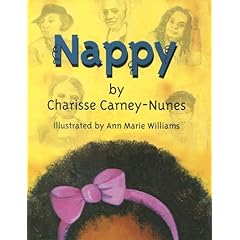
Someone gave Firefly a copy of the picture book Nappy by Charisse Carney-Nunes for Christmas. It's a bit beyond her reading (listening?) level right now, but Puppy asks for it on occasion.

The other day he looked up from the couch, where he sat with the book on his lap. "Firefly's hair is nappy!" he said happily, pleased with himself for making the connection.

I admit it stopped me in my tracks, hearing "nappy" coming from my white son's lips. Even though I knew full well it was being used innocently, even positively, in this specific instance, my gut reaction was negative. I had a flash of him--the only white child in the church--blithely labeling his African-American peers "nappy" the next morning at Sunday School.

I realized I was caught between parenting goals: wanting to affirm his connection of his sister's tight coils to those of the black historical figures celebrated in the book; needing to start teaching him why he and I can't use that word the same way Firefly can. If I have any sort of strategy (to use that word loosely) at this point with tiny Firefly, it is to work on creating a positive association with "nappy," so that when she hears it applied negatively to her hair for the first time--and I believe it is a question of when, not if--she will already have a sense of familiarity with and even ownership of the word. But even there I tread lightly, knowing that there is no one shared perspective on "nappy" among African-Americans. The one thing I know for certain is that it is not a word I, as a white person, should throw around casually, if at all. While I had thought some about familiarizing Firefly with "nappy," particularly after we were given the book, I had neglected to think about my approach with Puppy. He was picking up the positive association but without any of the cultural context he also needed. (Perfectly understandable for a four-year old.)

"Firefly's hair is nappy," I agreed. "It's one of the ways to describe her pretty curls. It's a word we can use here at home with our family. But it's not one that we should use with people who aren't in our family."

"Why?"

"It's a word that some people use to be mean. They call hair 'nappy' as a way of saying someone's hair doesn't look nice. And when someone who isn't in our family hears you using it, they won't be able to tell whether or not you're being mean. You could hurt their feelings."

"People think 'nappy' is mean?"

"Some people do. They are often people who have straight hair and pink skin like you and I do, instead of curly hair and brown skin like Firefly. If we tell a curly-haired person that their hair is nappy, they might think we're trying to be mean at them.* When you're older it will be easier to figure out when you can use the word 'nappy.' But while you're little it's better if it's a family word."

My off-the-cuff response seemed to be enough for him that night. Later that weekend I overheard him making sure Todd knew that "nappy" was a family word, so I know he was thinking about it more. And he hasn't stopped reading the book, so I think so far he hasn't taken it as an over-correction.

It can be a tricky thing, raising my children of different races. Trickier than I think raising two African-American kids would have been, although I'm throwing guesses at the wind there. There are some specific things I need to pass onto each of them; chief among them for Puppy is what it means to be aware of his whiteness (among his other privileges). Teaching Firefly that "nappy" is her word to claim and define while simultaneously teaching Puppy that he can't do the same, at least not in the same way. There is a tension in trying to create a unified "us" as a multiracial family while also acknowledging that our family identity is different than our individual racial identities. Not overemphasizing that three of the four of us share whiteness, but not ignoring it either. Our multiracial-ness as family makes us visible in particular ways and sometimes changes how others interact with us. But parenting a child of color doesn't make me a person of color; being a brother to a black sister doesn't make Puppy black.** When any of us leaves the house without Firefly, our multiracial family identity becomes invisible to others.

It's not the first of these sorts of moments with Puppy and I know it won't be the last. I'm interested in knowing if others of you with similar family make-ups ever feel that same tension.

* This is a Puppy grammar quirk. You're mean at people, not mean to people. He insists on it. Don't ask me why.
**You might be saying, "Well, duh, Heather." But you see that sometimes here and there, white transracial adoptive parents who announce they're an African-American/Chinese/Ethiopian/etc. family now because of their child's background. I suspect they're trying to describe how their perspective on race and culture has changed, or their efforts to embrace their child's heritage. But I think they take it a bit far. I didn't trade in my whiteness the day Firefly came home.

December 07, 2009

Digging Into the Comments

Firefly must have not been pleased that I wrote about her hair, because she pitched a ginormous hissy fit Saturday morning midway through post-bath hair time. Which is why she spent the day wandering around the house with only the front right side of her hair braided. I pick my battles, people. By Sunday morning she had gotten over it, so there you go.

I wrote that post in the middle of the night, hence the wandering train of thought. I almost didn't publish it because I didn't like that there was no organizing point. But it has been interesting to see how different readers interpret it. Lots of chewy things came up in the comments that I want to talk about. It's too much for one post, so I'll jump in and see how far I get.

For the record, I think hair is important in transracial adoption. Full stop. Being proficient in caring for Firefly's hair--and communicating to her how beautiful we think it is--is a definite piece of what Todd and I see as our transracial parenting responsibilities.

Listen to John Raible, an adult transracial adoptee, give his perspective on the importance of hair care (the camp he refers to is PACT Family Camp):
I’ve watched African American girls come to camp their first time with “jacked up” hair (and damaged self-esteem). After spending an intimate session at the Hair Clinic, these same girls emerge feeling beautiful, with a freshly conditioned scalp and gorgeous new braids. I liken the state of black children’s hair to the proverbial canary in the coalmine, by which I mean that many of us who are transracial adoptees survey the children’s hair to get a sense of where the parents’ heads are at—quite literally—in terms of their attention to African American cultural values and their commitment to instilling racial pride in their children. There’s an in-joke among black and biracial transracial adoptees that we can tell who was raised by white parents just by looking at the hair. It excites me no end to witness head after head of lovingly cared for hair among the young campers. I particularly love to chat with little girls about who braids their hair, and watch as they beam with pride, “My mommy (or daddy) did it.”
Because my own hair (no texture, no curl) is different from my daughter's (textured, tightly curled), I've spent a good deal of time learning about curly hair care. She's not even two yet, so it's not like we're getting super fancy with styles. Not to mention for the good part of her first year she had some truly unfortunate patchy baldness going on. But her hair is healthy and attended to. We make sure it's presentable when we're out. We've gotten good feedback about it from people who know what they're talking about. I wouldn't say I'm proud of those facts; pride doesn't seem like the right response to something as elemental as being able to take care of your child's hair. It would be like being proud that I dress them appropriately; it's a matter of basic parenting. But I am pretty confident we're at least on the right track at this point in practical hair matters, even as we're still learning.

Because my cultural and social experience of hair is different from what my daughter's is and will be, I've also spent time learning more about that. That, to me, is a much more complex and meaty topic than figuring out a basic hair care routine. It's also a much more delicate issue to approach as a white woman. I'm not about to pretend to understand the many interlocking factors that might be involved in an individual black woman's decision about relaxers vs. natural hair, for example. That's not a conversation I can insert myself into. But it's important that I learn about the kinds of conversations that go on. Because I need to to understand the cultural backdrop to the choices we're making for Firefly's hair right now, and what I might be communicating to her and others with those choices.

Look back at the quote up above: the writer isn't encouraged by the parents who are good at hair care simply for the sake of the kids having well-maintained hair. It's because he sees those efforts as indicators of the parents' "attention to African American cultural values and their commitment to instilling racial pride in their children." Those are huge tasks. Neither is possible through hair care alone.

Ask little Firefly, "Who has pretty hair?" and she throws her hands on top of her head and squeals. When I carry her to the mirror to coo over her beautiful face and latest 'do after hair time, she grins and claps at her reflection. That is worth something, even at her young age. But it isn't enough.

I could become an expert in all things black hair, surround her with positive images in books and artwork, learn how to do intricate styles to near-professional quality, and send Firefly out of the house every day for the next dozen years perfectly coiffed.  But if she is never connected to an African-American community, if she has no African-American peers or mentors, if home isn't a place where racism is recognized and discussed, then what good will all that great hair have done? A good portion of transracial parenting happens outside the walls of our home: the social networks we create, the places we choose to live, the ways we help our children process and understand the things that happen to them as they move through life. And those things are a hell of a lot harder to tackle than finding a good leave-in conditioner. When I listen to transracial adoptees' stories, I hear talk about hair, but I also hear a whole lot more about feelings of isolation and a need for safe spaces to explore racial identity. That's why the disconnect I saw among some of the white parents in that particular online discussion group was so striking to me. How do you pat yourself on the back for the hours you've devoted to perfecting cornrows (and talking about them online), but not take time to learn more about the realities of racism in your country?

Next: public comments, hair touching, the styling paradox

December 03, 2009

Let's (Not) Talk About Hair

We are at a Christmas activity night for children. Puppy busies himself making a card while Firefly runs in circles nearby.

The white woman next to me leans over conspiratorially and points at Firefly. "Her hair is that cute stage now, but just wait until she gets older. Then you have to deal with all the straighteners. Actually, it's the bill for the straightener that's the problem!"

She laughs. I take one step sideways.

Two girls make their way toward us from across the room. They look like they are in junior high, maybe early high school. Earlier someone told me they were sisters. One is fair, her long blonde hair hanging in a long diagonal across her forehead. The other has light brown skin, her overly processed hair awkwardly pushed across her face in an approximation of her sister's.

After they reach us, the mother nudges the dark-haired girl. "I was telling her that the little girl's hair is cute now like yours was, but just wait until she gets older and it all goes crazy," she chuckles.

Her daughter winces.

***

My daughter's hair reaches out to touch the sky. Tended gently, it fluffs into a soft halo around her face. Caress each strand and tiny, perfect corkscrews appear beneath your fingertips. It is beautiful.

***

I'm lurking at an online discussion group made up of white adoptive mothers of black children. The central topic is their children's hair, the care and styling of. A lot of them seem to know what they're talking about. They field questions from newbies, swap techniques for braiding and styling. I pick up some good recommendations.

They devote enormous amounts of time to researching products, elaborate styles, and methods. When their daughters enjoy their hair, they are proud. They are thrilled to find books and dolls that reflect their daughters' features. It is the group's unofficial mantra that by sending them out with perfect hair they will instill in them a sense of racial pride. It will make it okay to be a brown face in a house of white. The hours spent on their hair are a show of their love.

Some admit that their children live in areas in which they almost never see another black person outside their household. One mother shares a story on her blog of her son's first day living as a young black man in America, a twelve-year old West African boy plopped into an almost exclusively white rural community. He got a "fun surprise," she says, when a police officer friend of hers "playfully" handcuffed him and put him in the back of his squad car. She finds this hilarious. The commenters do, too.

When one mother says she's troubled that people often touch her child's hair without permission and wonders if she's being oversensitive, only one or two recognize the violation the touching is. Most brush off any racial overtones. Many say the hair petting is a compliment. "I don't see why we need to drag race into everything," another poster snits.

It's as if people plucked out "learn to care for your adopted child's hair"--the one thing that perhaps felt safe, felt like something they could take hold of and learn and master--and made it out to be the secret key to transracial parenting. No historical, sociological, or relational context. I can't help but think that they're missing the point.

***

My son's hair lies smooth and flat around his head, save for the interminable cowlick at the crown. When it's time for a haircut the front pieces sneak down to tickle his eyebrows, the sides creep out over the tops of his ears. It shines like gold seen through the hazy filter of a dream. It is beautiful.

No stranger has ever, that I recall, struck up a conversation about my son's hair outside of a salon.

***

In the time Firefly has been in our family, only a few (mostly white) strangers have ever mentioned her race. Dozens and dozens (almost always white) strangers have commented on her hair. Frankly, her hair is quite ordinary amongst the curly-haired babies of the world. I imagine most of them exclaim, "Look at her hair!" when what they want to say is "Look, she's not white!"

***

People write essays judging famous white adoptive parents' ability to raise black children because their hair isn't neatly braided in public. Other people write essays telling them to shut up already.

I read and take mental notes, but it's already feeling like familiar territory. I know I'm being watched, too.

And I'm watching.

We're at a museum in Big City when I spot a white woman with two teenage African-American girls. They look like a family. The girls' hair is lovely, done up in way that has the air of casual simplicity but actually takes quite a bit of skill to pull off.

The mother notices us. I see her eyes travel the familiar path strangers take: Firefly's face, to me, to Todd and Puppy, back to Firefly. Her eyes go one step further, lingering for a moment on Firefly's hair in its twists. She gives me the upward chin nod of recognition.

During that same day while we are still in Big City, two more white mothers of black daughters stop to ask me questions about Firefly's hair.

***

In the mornings Firefly sits in her high chair and eats her breakfast while I prepare her hair for the day. She ignores me unless I take too long, in which case she shakes her head vigorously to thwart my efforts. It's just another part of our morning routine, like putting on clothes or searching for our shoes. There is nothing exotic about it.

October 25, 2009

Little Church

Today was a Little Church day, a Sunday we worshiped at the AME Zion church in town. We've been alternating weeks between that congregation and (what used to be) our usual church since mid-summer.  Puppy dubbed them Big Church and Little Church based on the size of their buildings, but I'll bet most adults observing the two would think of them as "white church" and "black church."

There is an imbalance right now in our involvement between the two churches, since we've got a couple years' head start at Big Church. But our goal, in the near-term at least, is to be equally invested at them both. It's important to us that the kids see us parents giving and receiving instead of merely attending--especially at Little Church, so they can know that we're there because it's important to us, too, and not just for Firefly's sake. It's been slow-going. Todd joined a men's breakfast one weekend and bonded with a couple guys in that way he has. He has helped out in kids' church. We went to the big annual church picnic, where I got to know the family of a little girl Firefly's age and Todd somehow managed to inspire a giant game of football. We've started to learn people's names and have conversations that go beyond banal pleasantries--small things, but ones that feel like a big deal when you're getting to know a new community. Todd and I attended a fundraiser on Saturday for a local group researching the history of African-American pioneers in our state. We'd been to their events before, but this was the first time we've walked in and been able to greet people we knew. It feels like our baby steps venturing out are beginning to pay off in small ways.

There is a certain self-consciousness walking into a black church that first time as white parents with a black child in your arms, at least for me. It's easy to convince myself that everyone is looking at us and thinking that we're only there because of Firefly. But that was more or less true in the beginning, so I figured I might as well own it. And the members have been nothing but welcoming of our whole family. Not that I expected them to not be rude, but it really is a particularly warm congregation. (I've visited umpteen churches in my day, so I've got some basis for comparison.) Smaller churches often are.

We received an extra dose of that warmth today after the service. A woman came down the aisle as we were working to gather our things and hungry children. I apologized for the lot of us blocking her way and moved aside. "Oh, no," she said. "I actually came to talk to you."

She looked like she was in her mid- to late-forties. "I'm biracial," she continued, after we exchanged names. "My mom raised three of us biracial kids on her own. I've seen you here a few times now and I wanted to ask if you had any questions about how to do [Firefly's] hair. I know how hard it was for my mom."

She did a quick look and touch appraisal of Firefly's curls and deemed them well-tended (whoo). She quizzed me on a few of the basics of care and combing, I think mostly to make sure I wasn't torturing poor Firefly. We laughed about the total paradigm shift it is for women with fine, straight hair like mine (and her mom's) to deliberately work oil into hair.

We talked briefly about some of the tensions she felt growing up and what it's been like for her to live in our predominately white city. "Please, if there is ever any piece of advice or comment you'd like to say to us, feel free to just put it out there," I told her. "We won't be offended. We need people to tell us what we're doing wrong."

"I don't think it's a matter of right and wrong," she answered. "Maybe better and worse. What's most important is that love is underneath it all. I've watched you and it seems like you've got that part right. I just wanted to let you know I'm here. I've thought a lot about my experience growing up biracial and I feel like it's my mission to do something with that."

What a gift, you know? This woman saw Firefly and felt a kinship, and wanted to love on her by offering up her own experience and making sure we had our basic act together. She certainly didn't have to do that, but she chose to, and that means so much to me.

There is no grand point to this post, and I hope it doesn't come across like I'm patting us on the back. Lord knows we haven't earned the right to do that yet. These are teeny tiny steps we're taking, but ones that feel increasingly right.

January 21, 2009

The Evening of My Embarrassment

One evening last week I got to thinking about the inauguration and how I'd be working at home alone with no one but Twitter to share the happy moment. Woe is me. So I impulsively invited bunches of people over for dinner and a re-watch of the ceremony.

People responded and it was all quite exciting. I knew Puppy wouldn't remember watching the ceremony but he just might remember a party a tiny bit. We decided it fit in well with Operation Get Our (Local White) Friends to Acknowledge Race* we've got going on. To be as obnoxious as possible we made ribs and biscuits and greens and beans and macaroni and sweet potato pie and pandowdy. The night's mission: be introduced to collard greens and watch a biracial man assume the highest office in the the land. Discuss!

It was all going swimmingly until T mentioned--as we were setting the table--that he told his principal about the party and that she might stop by. Oh, dear. Throwing together dinner for your friends on a weekday evening is one thing. Cooking for your boss is quite another.

For this story to make sense, you also need to know that T's boss is African-American and has had a lot to say about our transracial adoption. And now she was coming to eat soul food made by little white me.

Just when I had talked myself into the fact that she's a huge fan of T and it would all be fine, she called to say she was on her way and she was bringing along the pastor of the black church we've been visiting. This is a man who has someone standing by to hand him a towel and water when he preaches and all we had were the sad leftovers of a buffet to offer up. Not really how I would have wanted our first sit-down with him to go.

It was the very tail end of the party when they arrived and most everyone else had left, so we sat down to chat with the two of them while they ate. They are hugely influential people in the church community we've been getting to know, not to mention in T's professional life, so I was already all kinds of self-conscious. (When I can't do my fretting well in advance, it just all comes out in one big burst of nervousness.) Then the pastor squinted appraising-ly at Firefly, who was rocking quite the head of post-nap fuzz. He turned to me and said, "Why isn't that girl's hair in ponytails yet?" As we stammered some sort of answer, he moved on to quizzing me about how we're conditioning it. And I just wanted to crawl under the table and hide.

Then T's boss went into our messy post-party kitchen and started doing the dishes and my head exploded.

But she did compliment my greens and ask me where in the world I learned to cook this kind of food so well (thank you, women at our old church!).

And the rest of the party was just what I wanted. We watched the inauguration and hugged our kids and smiled some teary smiles. And I went to bed for the first time in a whole lot of years feeling like I mostly trusted the people in power.

So, all in all, it was a good evening.

* Our friends are wonderful people. It's just that pretending to be "color-blind" is the most popular approach to race where we currently live.

October 30, 2008

Puppy and His Sister

Wow, you know the economy is bad when over 450 people enter to win a $15 gift card. Be sure to toss your name in the hat before tomorrow night if you haven't already. Sure, as of right now you only have a 0.2% chance of winning. But if you don't enter at all, your chances are 0%.

---

Some friends gave Puppy a toy camping set for his birthday with a car, canoe, tent--that sort of thing. There was a set of action figures included, a man and a boy. Puppy promptly decided they were father and son, then asked where the mommy and Firefly were. The other night, after several days of asking, he completely melted down. Suggesting that maybe the rest of the family just stayed at home for this camping trip didn't help. "I want a Mommy and a Firefly! We need to get a Mommy and a Firefly!" the tired boy cried.

I've been poking around online to see what I could find for him. The toy's manufacturer only sells white, male figures, so they were no use to me. I found some figures from another company that should work, but they are only sold in sets. So now there was a new question: do I buy the white mom and baby or the African-American ones?* Would Puppy even care?

It is hard to know what racial differences Puppy notices at this point. He compares other aspects all the time. He talks about Firefly being a baby and him being a toddler. He will say that she is a girl and he is a boy. He comes into the bathroom in the morning to watch me do her hair and compares his short, straight hair to her longer curls. We were reading a book one night and came to a page with a picture of an African-American man tossing his baby girl in the air. "Look! It's a Firefly baby!" said Puppy. "What about this baby makes you think of Firefly?" I asked. He leveled me that look toddlers give when you ask an obvious question. "She's a baby!" he explained. Duh, Mom.

Between the election and transracial parenting, race comes up in our home most every day. And whether or not Puppy can use the language of race, he is experiencing being in an interracial family, seeing how others respond to us. I know he is taking it all in, unconsciously or not. He listens to us talking about race, watches me hold Firefly up to the mirror and compliment her pretty brown skin, hears the questions people ask (no one ever asks about his ethnic background, but we get that question all the time about Firefly). He's witnessed so many people comment on her hair that he heads it off as part of his stock introduction: "This is Firefly. She is my sister. Look at her curly hair!"

There is quite a bit written about the experiences of parents and children whose relationships cross racial lines, a little less about siblings whose do. It is not limited to adoption, of course. There are all sorts of blended families these days. Lately I've noticed myself reading with an eye on sibling relationships, looking for clues in the stories of other multiracial families. Puppy and Firefly will share the experience of growing up with T and me as their crazy parents. But Puppy will not know what it was like to grow up black in this family, or vice versa.

Adoption always has ripples, and our decision to adopt transracially subtly changed the nature of Puppy's adoption. Firefly made our adoptive family status visibly apparent, but it also made Puppy's adoption more hidden. Even after confirming that Firefly was indeed adopted, people are surprised to learn that Puppy was, as well. Only one has been gauche enough to ask why we "couldn't get another white kid" (my response was an incredulous, "Excuse me?").

As far as Puppy is concerned, this is just the way his family is and he doesn't think to question it. When an older kid told him that Firefly couldn't be his sister because they didn't look alike, he was too confused by the thought to answer. We are receiving wonderful advice about giving Firefly tools she can use as she grows up a biracial child in a white family, advice which I hope we'll be able to follow. Now I'm looking at my white child and thinking about how to do the same for him.

* I'm getting the African-American ones. Lord knows we'll have enough Caucasian action figures in our house over the years.

October 13, 2008

We Went to Church

That was fun! A big thanks to everyone who delurked. My favorite part was seeing how familiar most of you already were to me. Of all the bloggers who commented, I think I already read all but a few of their blogs. And now I have some extras to add to my reading list.

Comments will remain open on that post indefinitely, so feel free to delurk there any time you please.

***

Yesterday we made our first visit to one of the African-American churches in town. We had been invited more than once since we moved here a couple of years ago. It took us this long to stop talking about visiting and actually go visit one Sunday. Inertia is a powerful force in our home.

Based only on my observation, there were a couple of interracial families in attendance and what might have been one other transracial family. Mostly there were lots and lots of African-American families, which is not the norm in our corner of the country. For only the second time in her life it was T, Puppy and I who stood out, and not Firefly.

I once saw an adoptive parent ask on a forum which was more important for transracially adopted children: being around other transracial adoptees or being around adults and families of their own race/ethnicity. I was surprised to see the overwhelming majority of parents choose being with transracial families as more important. Not because I'm certain they're wrong, but because it wasn't my own gut response.

Like many white people who grew up in this area--not all, but many--I have a specific memory of the first time when I was one of the only white people in a room. I was a teenager at the time and I remember suddenly being very aware of my context and a little uncomfortable. It wasn't until after living in northeast Los Angeles, where such situations were part of my daily life, that my hyperawareness got dialed back.

Firefly will likely grow up in the minority of the room every single day--not only in her larger community, but in her own home. While T and I are seeking out other transracial adoptive families (because there is a uniqueness in that experience), we're also hoping it becomes a familiar thing for her to surrounded by African-Americans of all ages. If for no other reason than to give her space in which to rest from being the outwardly different one (although obviously her white parents make her more visible). She'll spend more of her life grown and on her own than she will living with us, and during that time she'll be faced with all sorts of choices about how to identify herself and in which communities to plant roots. We're hoping to at least give her varied enough experiences in her childhood that she doesn't feel like she's going into those choices completely blind.

And perhaps there will be some significance for Puppy and Firefly to see their parents deliberately stepping outside of comfort zones for the sake of building bridges. Being around other transracial adoptive parents is easy for me. Walking into a black church with an adopted baby in my arms for the first time? That took a little more nerve.

But everyone was wonderfully friendly and all in all, it went well. I did realize how weak my church muscles have become when I grew fidgety around the two-hour mark. Poor Puppy couldn't make it through, so one of us ended up playing cars with him for most of the time. There were lots of other kids of all ages milling around in the back, though, so I think it was okay. We're thinking through how to balance involvement there with our other church, but I do hope we'll be back soon. Participating in that church community won't magically balance out the rest of Firefly's world, but it felt right to be there and to have Firefly there. One small step of many.

September 23, 2008

Tooting My Tiny Horn

A vintage post of mine about wee Puppy's shoes--Orange--managed to make runner-up in the Scribbit September Write-Away Contest. A small, but happy thing in my week.

At the risk of oversharing: my whole life I've heard Mr. Rogers singing "I'm proud of you, I hope that you are proud of you, too" inside my head whenever something good happens. This is what a lifetime of PBS has done to me. Does anyone else have a childhood song you just can't shake?

I also want to point you to one of the other runners-up, who coincidentally was fellow adoptive parent Tongga Mom. She wrote an excellent piece about race, colorblindness and transracial parenting: Seeing Color. Definitely worth clicking through to read.

August 04, 2008

Fading into the Background

Gold stars all around if you can tell me what's missing from these magazine covers:


Aw, how sweet. The Jolie-Pitts have become a beautiful family of five.

What's that you say? They actually have other three other children? Don't be silly. Everyone knows adopted kids aren't really family, especially those embarrassingly obvious transracial adoptees.

I'm not surprised, but I am royally annoyed. Especially since their eldest child is old enough to read and understand this slight.

Bonus gold star if you can answer this head-scratcher: if one of their adopted children was white, would he/she ha
ve been acknowledged on the cover? My guess is still no.

July 25, 2008

A Bathroom Conversation

We went briefly with Ms B to a small church thing so she could introduce the group to Firefly. I was in the bathroom changing a diaper when a woman came through with her young son. I honestly thought she knew Ms B, which was the only reason I let this conversation go the way it did. I didn't want to be rude to someone in Ms B's world.

"Is that your baby?"

"Yes."

"Out of your body?"

"No, it was an adoption."

"Is she black?"

"Yes--well, she's biracial."

"Why do people always pick the biracial ones?"

I decide to ignore both the truth in her statement and her assumptions about me. I'm now keenly aware that she is African-American and I am not. "Well, we didn't pick her, her mom picked us."

"Is your husband black?"

"No, he's white."

"Huh. So why'd she give her to you?"

"I think you'd need to ask her. She's [Ms B]'s baby. [Ms B Lastname]?" I gesture toward the room outside.

"I don't know her. Wait, so her mom still sees her?"

"Yes, that's what open adoption is."

"That must be hard on you."

"Well, I think about her [Firefly] in the future and how much harder it would be for her to not know all her parents or where she came from."

"Are you going to have your own kids?"

"Probably not. And she is my own." I look down at Firefly and she squeaks happily.

"Look, she knows who you are. You're her new mom."

"Mmm-hm. I'm one of her moms."

"She seems happy. She's cute."

"Thanks."

"Weird." She starts to leave. "This parenting thing. I don't know. I didn't know how hard..." She gestures at her son. "Will you take mine?"

July 14, 2008

Pretty Girl

I was sitting by the water this weekend with nothing to do but chat and read my book (which is pretty much all I ask for from a vacation at the moment), so Firefly got her first bitty twists.
I didn't have a comb or product, just a cup of water, so it was a little messy. I tried it again the next day and it looked better. But in order to be "authentic" and "honest" and all that, I resisted swapping in the second-day photos.
It was a fun diversion for me, but it also unexpectedly sparked a really good discussion with the other folks in that corner of the deck about transracial parenting. This is a group of four families with whom we go to the same cabin each year, a tradition started when we were still single, childless college students. Of the eleven kids between us, ten have blond hair and blue eyes. The eleventh is Firefly. I think there has been some uncertainty among them about whether it's okay to acknowledge Firefly's race or if they're supposed to pretend to be colorblind. Somehow twisting up her curls in a way none of their daughters' silky hair would ever go opened the floor for them to ask the questions they'd been holding onto.
Related Posts Plugin for WordPress, Blogger...